Artificial intelligence, or AI, is changing digital marketing. Today, AI tools can write content, create images, study data, and help run ad campaigns. They can also help businesses understand their customers.
This has raised an important question: can digital marketing be replaced by AI?
The short answer is no, not completely.
AI can do many digital marketing tasks. It can save time and reduce manual work. But digital marketing needs more than tools and data. It also needs ideas, planning, creativity, and an understanding of people.
A good marketer knows what customers want. They also know how to build trust and create a strong brand. AI can help with these tasks, but it cannot fully replace human judgment.
The future of digital marketing will most likely include both AI and human marketers. Marketers who learn how to use AI can work faster and focus more on important tasks.
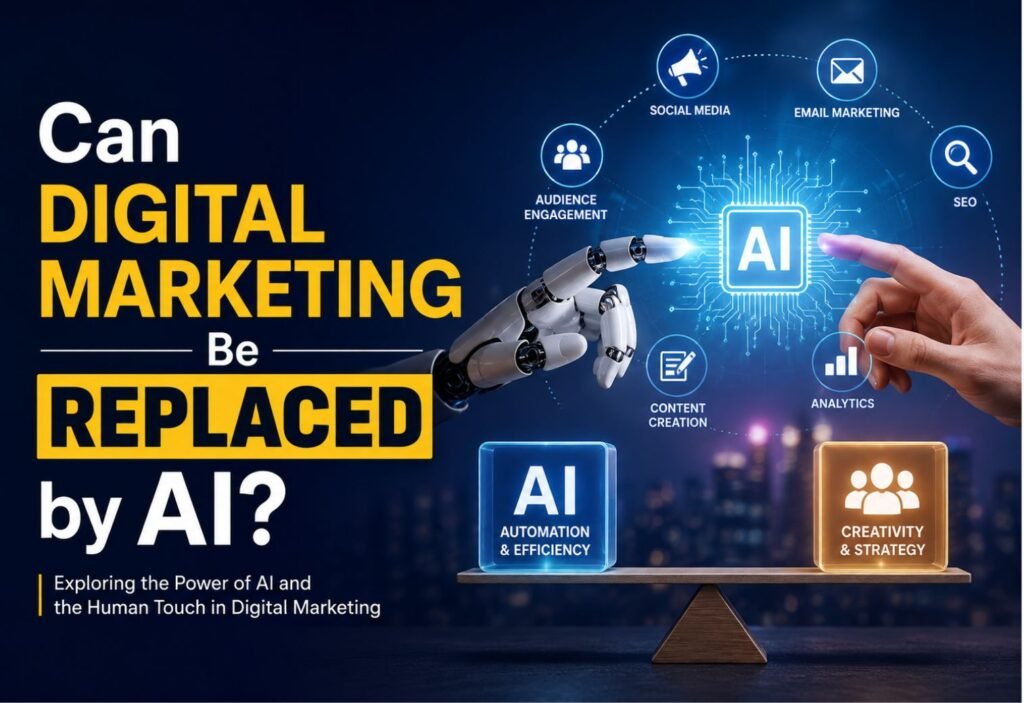
Can Digital Marketing Really Be Replaced by AI?
AI can already do many tasks that digital marketers used to do themselves.
For example, AI can write a social media post in seconds. It can suggest keywords for SEO. It can create an email draft. It can also study campaign data and find useful patterns.
Because of this, some people believe AI may replace digital marketers in the future.
But digital marketing is not just about completing tasks. It also involves making decisions.
A business needs to know:
- Who are its customers?
- What do those customers need?
- What problems do they face?
- What makes the brand different?
- What message should the brand share?
- Which marketing strategy will work best?
AI can provide useful information. But a human marketer still needs to make many of these decisions.
For example, imagine a company launches a new skincare product. AI can create different ad copies and suggest keywords. It can also study customer data.
But a marketer must decide how the brand should present the product. They must understand the target audience and choose the right message. They also need to make sure the message fits the brand.
This shows an important difference:
AI can help marketers do their work. It does not mean AI can do all of their work.
What Can AI Do in Digital Marketing?
AI can now help with many common marketing tasks.
Some examples include:
- Content creation: AI can create blog drafts, captions, product descriptions, and ad copy.
- SEO: AI can suggest keywords, analyze search intent, and help create content ideas.
- Social media: AI can help create posts, content calendars, and publishing schedules.
- Paid advertising: AI can help analyze ads, audiences, and campaign results.
- Email marketing: AI can create email drafts and personalize messages.
- Data analysis: AI can study large amounts of marketing data quickly.
- Customer support: AI chatbots can answer common customer questions.
- Content ideas: AI can suggest topics based on keywords and audience interests.
These tools can save marketers a lot of time.
For example, a marketer may spend hours researching keywords or creating the first draft of an article. AI can complete the first part of this work much faster.
But the marketer still needs to check the information. They need to edit the content and make sure it matches the brand.
So, the real question is not “Will AI replace digital marketing?”
A better question is:
“Which parts of digital marketing can AI replace, and which parts still need humans?”
The answer to this question can help us understand what the future of digital marketing may look like.
Why Is AI Changing Digital Marketing?
AI is changing digital marketing because it can handle large amounts of work in a short time.
In the past, marketers had to spend many hours on research, data analysis, content creation, and reporting. AI can now help with many of these tasks.
One major benefit is speed. AI can process information much faster than a person. It can study customer data and find patterns within seconds.
AI also helps marketers create more personalized content. For example, businesses can use customer data to show different messages to different groups of people.
AI can also help businesses reduce repetitive work. A marketer does not have to write every email or check every piece of data manually.
This gives marketers more time to focus on strategy and creative work.
Here are some of the main ways AI is changing digital marketing:
- It makes research faster.
- It helps create content quickly.
- It improves data analysis.
- It supports personalized marketing.
- It helps automate repetitive tasks.
- It can improve ad performance.
- It helps businesses understand customer behavior.
- It allows marketers to test more ideas.
However, using AI does not mean that businesses can remove humans from the marketing process.
AI still needs human direction. Marketers need to tell AI what they want, check its results, and decide how to use those results.
Which Digital Marketing Tasks Can AI Replace?
AI can replace or automate some parts of digital marketing.
Most of these tasks are repetitive. They also involve data, patterns, or simple processes.
This does not mean that AI will replace every digital marketing job. It means that some tasks may require less human effort than before.
Let’s look at some common examples.
Content Creation
AI can create many types of marketing content.
It can help write:
- Blog drafts
- Social media captions
- Product descriptions
- Email drafts
- Ad copy
- Content ideas
- Video scripts
This can save a lot of time.
However, marketers should not publish AI content without checking it. AI can make mistakes. It can also create content that sounds generic.
A human should review the content before publishing it. The marketer can add personal experience, useful examples, and the brand’s own voice.
So, AI can help with content creation. But human editing still matters.
SEO and Keyword Research
AI can also help with SEO.
It can find keyword ideas and group similar keywords. It can also help marketers understand what people are searching for.
For example, if someone wants to write about digital marketing, AI can suggest related topics such as:
- AI in digital marketing
- Digital marketing jobs
- SEO and AI
- Future of digital marketing
- AI marketing tools
AI can also help marketers study competitors and find content gaps.
But SEO is not only about keywords.
A good SEO strategy also needs strong content, good user experience, technical SEO, and a clear understanding of the target audience.
This is where human knowledge still plays an important role.
Social Media Marketing
AI can automate many social media tasks.
It can help marketers:
- Write captions
- Suggest post ideas
- Create content calendars
- Analyze engagement
- Find suitable hashtags
- Schedule posts
This can make social media management much faster.
But social media also needs human interaction.
A brand needs to respond to customers. It needs to understand trends and handle negative comments. It also needs creative ideas that connect with its audience.
AI can support these tasks, but it cannot fully replace the person managing the brand’s social presence.
Paid Advertising
AI has become useful in online advertising.
It can study ad performance and help businesses find better audiences. It can also help test different ads and improve campaign performance.
For example, AI can compare different headlines and identify which one gets more clicks.
It can also help businesses understand which audience is more likely to convert.
But marketers still need to set the campaign goals. They also need to decide how much the business should spend and what the campaign should achieve.
AI can provide recommendations. The final decision still needs human judgment.
Email Marketing
AI can make email marketing easier.
It can create email drafts and suggest subject lines. It can also help businesses divide customers into different groups.
For example, a business can send one email to new customers and a different email to existing customers.
AI can help decide which message may work better for each group.
But marketers still need to check the message. They need to make sure the email sounds natural and matches the brand.
What Can AI Not Easily Replace in Digital Marketing?
AI can handle many tasks. But some parts of marketing still need people.
These tasks often involve creativity, emotions, strategy, and human relationships.
Creativity and Original Ideas
AI can generate ideas. But marketers still need to decide which ideas are worth using.
A successful campaign needs more than words and images. It needs an idea that people remember.
For example, a company may ask AI to create 20 ideas for a social media campaign.
AI can provide the ideas quickly.
But a human marketer must decide which idea fits the brand and its customers.
Human creativity also comes from personal experiences, culture, emotions, and real-world observations.
These are difficult to copy with AI.
Understanding Human Emotions
People do not always buy products because of facts.
They may buy because of trust, fear, excitement, comfort, or personal connection.
A good marketer understands these emotions.
For example, an advertisement for a luxury product may focus on status and experience. An advertisement for a safety product may focus on trust and security.
AI can analyze customer data and suggest patterns. But humans still play an important role in understanding the deeper reasons behind customer decisions.
Marketing Strategy
AI can give marketers useful suggestions.
But a business still needs a clear marketing strategy.
A marketer may need to decide:
- Which audience should the business target?
- What should the brand offer?
- Which platform should it use?
- How much money should it spend?
- What should the campaign achieve?
- How should the brand stand out from competitors?
These decisions can affect the entire business.
AI can support the process, but human marketers need to connect marketing decisions with business goals.
Brand Voice and Identity
Every strong brand has its own personality.
Some brands sound friendly. Others sound professional. Some use humor, while others use a serious tone.
AI can copy a writing style when given clear instructions. But humans still need to define what the brand should sound like.
They also need to make sure the brand stays consistent across its website, social media, advertisements, and emails.
Building Relationships
Marketing is also about people.
Marketers often work with clients, customers, influencers, content creators, and other businesses.
They need to communicate clearly. They need to build trust and solve problems.
AI can help with communication, but it cannot fully replace human relationships.
People still want to speak with other people when they have complex problems or important decisions to make.
AI vs Digital Marketers: What Is the Difference?
AI and digital marketers have different strengths.
AI works well with data, repetitive tasks, and large amounts of information.
Human marketers are better at strategy, communication, creativity, and understanding context.
| Marketing Task | AI | Human Marketer |
|---|---|---|
| Data analysis | Very strong | Strong |
| Keyword research | Very strong | Strong |
| Content drafts | Very fast | More creative |
| Repetitive tasks | Excellent | Time-consuming |
| Customer emotions | Limited | Strong |
| Brand strategy | Limited | Strong |
| Creative direction | Helpful | Strong |
| Business decisions | Provides suggestions | Makes decisions |
| Relationship building | Limited | Strong |
This shows why AI and digital marketers should not always be viewed as competitors.
In many cases, they can work together.
A marketer can use AI to complete repetitive tasks. This gives the marketer more time to focus on strategy and creativity.
The future may not be AI versus digital marketers.
It may be AI-powered digital marketers versus marketers who do not use AI.
Will AI Replace Digital Marketing Jobs?
AI will change many digital marketing jobs.
Some tasks that once required a full-time employee may become automated. This could reduce the need for people to perform basic and repetitive work.
For example, a business may not need a person to create every social media caption manually. AI can help with that work.
The same applies to basic content drafts, simple reports, keyword research, and some customer support tasks.
But this does not mean that all digital marketing jobs will disappear.
Many marketing roles require skills that AI cannot easily replace.
SEO Specialists
SEO specialists need to understand search behavior, websites, content, and business goals.
AI can help with keyword research and analysis. But SEO specialists still need to create and manage the overall strategy.
Content Writers
AI can create basic content quickly.
This may affect writers who only produce simple and repetitive content.
However, writers who can research topics, tell stories, share expert knowledge, and create original ideas can still provide strong value.
Social Media Managers
AI can help create and schedule posts.
But social media managers still need to understand the audience. They also need to manage online communities and respond to customers.
Performance Marketers
AI can analyze advertising data and suggest changes.
But performance marketers still need to understand business goals. They also need to decide how to use the data.
Digital Marketing Managers
Marketing managers handle larger decisions.
They may manage budgets, teams, clients, campaigns, and business goals.
AI can support these managers, but it cannot easily replace their leadership and decision-making skills.
So, some digital marketing jobs may change. Some tasks may disappear. New tasks will also appear.
The key is to adapt instead of resisting the change.
Will AI Create New Digital Marketing Jobs?
AI may remove some tasks, but it can also create new opportunities.
As businesses use more AI tools, they will need people who understand both marketing and AI.
Some emerging roles may include:
- AI marketing specialist
- AI content strategist
- Marketing automation specialist
- AI SEO specialist
- Marketing data analyst
- AI-powered performance marketer
- Conversion rate optimization specialist
These roles combine traditional marketing skills with new technology.
This means marketers do not need to compete with AI.
They need to learn how to use it.
What Skills Should Digital Marketers Learn in the AI Era?
The digital marketing industry is changing.
Marketers now need more than basic marketing knowledge. They also need to understand AI and data.
Here are some important skills to develop.
1. AI Skills
Learn how AI tools work and how to use them properly.
You should also understand their limits.
2. SEO
Learn search intent, keyword research, technical SEO, content strategy, and website optimization.
3. Data Analysis
Learn how to read marketing data.
Knowing what the numbers mean is more important than simply creating reports.
4. Copywriting
Learn how to write content that connects with people.
Good copy should be clear, useful, and persuasive.
5. Strategic Thinking
Learn how to connect marketing activities with business goals.
Do not focus only on views, likes, or clicks.
Understand what helps the business grow.
6. Creativity
Develop your ability to create new ideas.
AI can give you suggestions, but you should learn how to turn those suggestions into original campaigns.
7. Conversion Rate Optimization
Learn why people take action on a website.
Understand what makes people click, sign up, contact a business, or buy a product.
8. Communication
Good communication will remain important.
Marketers need to work with customers, clients, teams, and business owners.
These skills can help marketers stay useful even as AI becomes more powerful.
How Can Digital Marketers Use AI Instead of Competing With It?
The best approach is to use AI as a tool.
A simple marketing workflow can look like this:
Step 1: Set the goal
The human marketer decides what the campaign needs to achieve.
Step 2: Use AI for research
AI can help find keywords, topics, trends, and customer insights.
Step 3: Create the strategy
The marketer decides which ideas to use and how to reach the target audience.
Step 4: Use AI for execution
AI can help create drafts, captions, images, emails, and other marketing materials.
Step 5: Review the work
The marketer checks the content for accuracy, quality, tone, and brand fit.
Step 6: Launch the campaign
The business publishes the content or starts the campaign.
Step 7: Analyze the results
AI can help study the data and identify patterns.
Step 8: Make improvements
The marketer uses the data to decide what should change.
This approach gives both sides a clear role.
AI handles more of the repetitive work. Humans handle the important decisions.
Advantages of Using AI in Digital Marketing
AI can offer several benefits to marketers and businesses.
Saves Time
AI can complete many tasks much faster than humans.
Reduces Repetitive Work
Marketers can automate tasks such as basic reporting, content drafts, and data sorting.
Improves Productivity
One marketer can manage more work with the right AI tools.
Supports Personalization
AI can help businesses create different messages for different customer groups.
Helps Analyze Data
AI can study large amounts of information and find patterns quickly.
Supports Better Decisions
AI can provide useful insights that help marketers understand campaign performance.
However, businesses should not depend on AI for every decision.
Human review remains important.
Limitations and Risks of Using AI in Digital Marketing
AI is useful, but it also has limitations.
First, AI can make mistakes. It may provide incorrect information or misunderstand a question.
Second, AI-generated content can sound similar to other content. If businesses depend too much on AI, their content may lose its unique voice.
Third, AI does not always understand context. A message that looks correct may still be wrong for a specific audience or situation.
There are also concerns about privacy, copyright, and the use of customer data.
Another risk is overdependence on AI.
If marketers allow AI to make every decision, they may stop developing their own skills.
The best approach is simple:
Use AI to support your work, but do not stop thinking for yourself.
The Future of Digital Marketing: Humans + AI
The future of digital marketing will likely combine human skills with AI technology.
AI will handle more repetitive work. It will also become better at analyzing data and automating campaigns.
Human marketers will continue to focus on areas such as:
- Strategy
- Creativity
- Brand building
- Customer relationships
- Decision-making
- Communication
- Campaign ideas
This means the role of a digital marketer may change.
Instead of spending most of the day doing manual tasks, marketers may spend more time planning campaigns, reviewing AI-generated work, studying customers, and making strategic decisions.
The marketers who learn to work with AI will have an important advantage.
Is Digital Marketing Still a Good Career in 2026?
Yes, digital marketing can still be a good career in 2026.
But the skills needed for the job are changing.
Learning only basic content writing, social media posting, or simple SEO may not be enough in the long term.
Marketers should learn how to use AI tools along with core marketing skills.
They should understand SEO, content, data, advertising, customer behavior, and strategy.
Most importantly, they should learn how to think like a marketer and use AI as a tool.
AI may replace some simple marketing tasks. But businesses will still need people who can understand customers, create strategies, solve problems, and make good decisions.
So, instead of asking whether AI will take your marketing job, ask yourself:
“How can I become a better marketer by using AI?”
That mindset can help you stay relevant as the industry changes.
